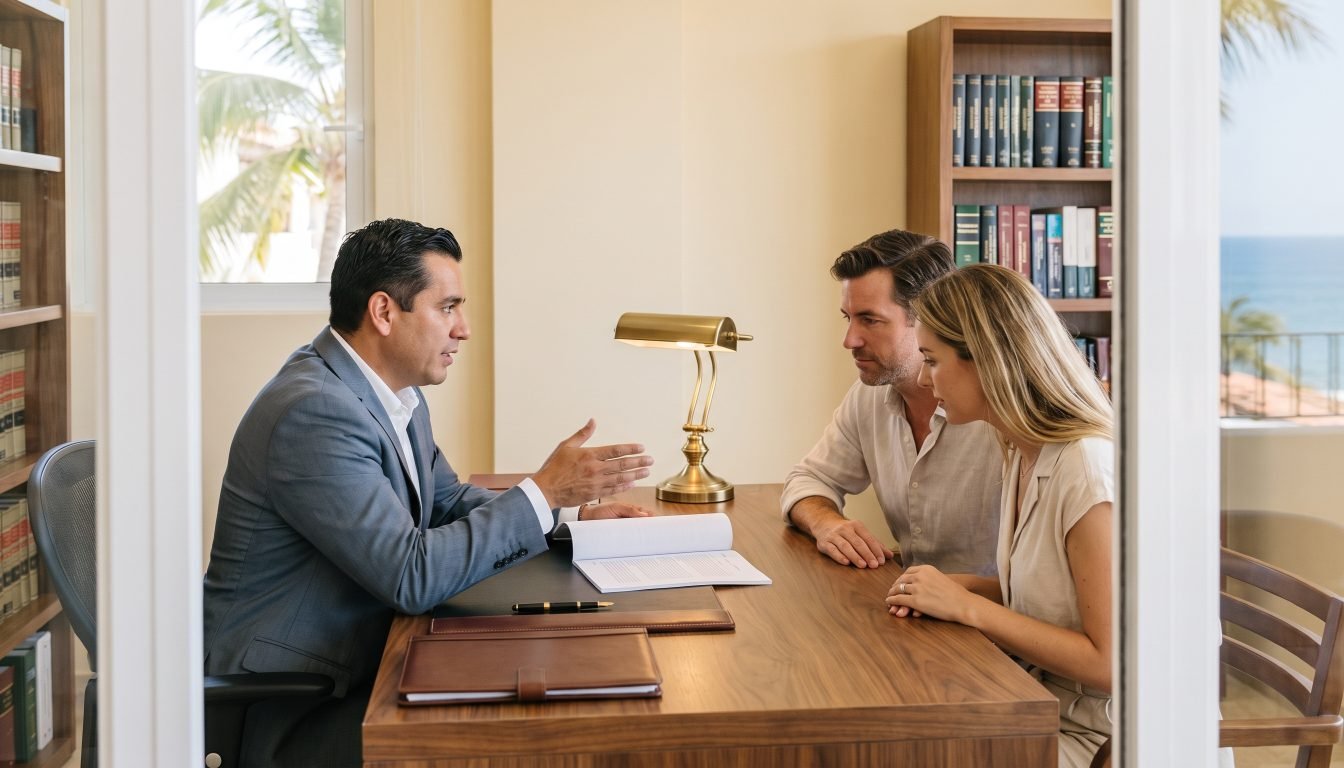
Sooner or later almost every foreigner who lives in, invests in or retires to Puerto Vallarta needs a lawyer: to close on a condo, renew a residency card, sign a lease, set up a company or deal with an estate. The legal system you will be dealing with is Mexican, written in Spanish and built on civil-law traditions that work very differently from the United States or Canada. That is why finding the right English-speaking lawyer in Puerto Vallarta is one of the most important decisions you will make here. This guide explains what a bilingual attorney actually does, how a lawyer differs from a Mexican notary, how to verify credentials, how fees usually work, the red flags to avoid and the questions to ask before you hire anyone.
Why you need an English-speaking lawyer in Puerto Vallarta
Speaking some Spanish is helpful for daily life, but legal Spanish is its own language. Contracts, public deeds, court filings and government resolutions use technical terms that do not translate neatly, and a single word — arrendamiento, poder, usufructo, fideicomiso — can carry obligations you would never guess from a dictionary. Every document that matters legally in Mexico is executed in Spanish, and the Spanish version is the one that controls, even if you were handed a courtesy translation.
An English-speaking lawyer in Puerto Vallarta closes that gap. The goal is not only to translate words but to translate consequences: what you are agreeing to, what happens if the other party does not perform, what deadlines you are now bound by and what the authority can ask of you later. When the attorney can explain all of that in plain English, you make decisions with the same confidence you would have at home.
The cost of a misunderstanding
The most expensive legal problems we see among expats rarely start with bad intentions. They start with a document that was signed without being fully understood: a purchase promise with an unrealistic deadline, a lease that silently renewed, a power of attorney that was broader than intended, a company whose shareholders were never properly registered. A bilingual lawyer's first job is prevention, and prevention is always cheaper than litigation.
What an English-speaking lawyer in Puerto Vallarta can do for you
Most foreigners need legal help in a handful of recurring areas. A well-rounded bilingual firm will either handle all of them directly or coordinate the specialists who do.
Real estate purchases and sales
Buying property in the restricted coastal zone involves a bank trust or a Mexican company, due diligence on title and liens, a promise-to-purchase agreement, escrow and a closing before a notary. Your attorney reviews each document, checks the property's legal history and coordinates with the notary so the deed reflects what you negotiated. Our real estate closing services in Puerto Vallarta cover this process from offer to registration, and bank trust (fideicomiso) services handle the structure foreigners use to hold coastal property.
Immigration and residency
Temporary and permanent residency, renewals, changes of status, work permits and family unity applications all go through the National Migration Institute (INM). The rules are clear on paper but full of practical details: financial solvency documents, appointment scheduling, the order of steps between the consulate and the local office. A bilingual team handling immigration services in Puerto Vallarta keeps your status in order and your deadlines on the calendar.
Business formation and corporate matters
Opening a Mexican company, registering with the tax authority (SAT), drafting bylaws, recording shareholder changes and keeping corporate books up to date are routine for a business attorney but confusing for a newcomer. See our corporation services in Puerto Vallarta and business legal services for what that work involves.
Contracts and negotiations
Leases, construction agreements, service contracts, partnership deals and settlements should be drafted or reviewed by someone who knows how Mexican courts will read them. Our legal contracts and negotiations practice is where most of this prevention happens.
Taxes, wills and estate planning
Rental income, capital gains on a sale and the annual obligations of a Mexican company all have tax consequences, and a Mexican will is the simplest way to make sure your property here passes the way you intend. A bilingual attorney coordinates with accountants for tax services and prepares the estate documents you need.
Disputes and litigation
When prevention fails — a contractor who disappears, a tenant who stops paying, a seller who will not deliver — you need someone who can represent you before Mexican courts and explain every filing in English. Even here, a good lawyer will usually explore negotiation and mediation first, because they are faster and cheaper than a trial.
Notary vs. lawyer in Mexico: not the same job
This is the single most common point of confusion for North Americans. In the United States or Canada, a notary public is someone who witnesses signatures. In Mexico, a notario público is an experienced attorney appointed by the state government after a rigorous selection process, and acting as a public official. The notary drafts and certifies public deeds, verifies the identity and legal capacity of the parties, calculates and withholds certain taxes on real estate transfers and sends the deed to the Public Registry of Property. Their signature gives a document full legal faith.
What the notary does not do
The notary is required to be impartial. They are not your advocate and they do not represent the buyer against the seller or the landlord against the tenant. They will make sure the deed is legally valid, but they will not negotiate your price, tell you whether the deal is a good idea or chase the other side for missing documents. That is your lawyer's job. You can learn more about how notaries fit into transactions on our notarías page.
How the two work together
In a well-run transaction, your English-speaking lawyer represents your interests, gathers and reviews documents, flags risks and negotiates terms, then delivers a clean file to the notary, who formalizes the act. In most real estate transactions the buyer has the right to choose the notary, and your lawyer can recommend one with experience in foreign-buyer closings. Think of the notary as the referee and your lawyer as your coach: you need both, but only one of them is on your side.
How to verify an English-speaking lawyer's credentials
Anyone can print "attorney" on a business card. Before you hire an English-speaking lawyer in Puerto Vallarta, confirm that the person is actually licensed to practice law in Mexico.
The cédula profesional
Every lawyer in Mexico must hold a cédula profesional issued by the federal Ministry of Education's Directorate of Professions. The cédula number can be checked in the public National Registry of Professionals (Registro Nacional de Profesionistas), which shows the holder's name, degree and the institution that granted it. Ask for the number in writing and check it yourself; a legitimate attorney will never hesitate to share it.
Foreign licenses do not count here
Some expats are drawn to a fellow countryman who was a lawyer "back home." A U.S. or Canadian license is valuable context, but it does not authorize anyone to sign court filings or give formal legal advice on Mexican law. If a foreign-licensed advisor is part of the team, make sure a Mexican attorney with a valid cédula is the one responsible for your matter.
Experience that matches your matter
Mexican law is broad and practice areas are specialized. A litigator is not necessarily the right person for a fideicomiso, and a corporate lawyer may not handle immigration day to day. Ask how many matters like yours the firm handled in the last year, whether the team works regularly with local notaries, trustee banks and the INM office, and who specifically will handle your file. Bar association membership is voluntary in Mexico, so it is a plus but not a guarantee.
Physical office and local presence
A real office in Puerto Vallarta, a landline or WhatsApp number that is answered, a professional email domain and a track record you can verify through reviews or referrals all point to a firm that will still be there when your matter takes longer than expected.
How legal fees usually work for foreigners
Fees vary widely with the complexity of the matter, so beware of anyone who quotes a price before understanding your situation. In practice, bilingual firms in Puerto Vallarta tend to use a few common structures.
Flat fees for defined services
Routine, well-defined work — a residency application, a standard lease, a company incorporation, a basic will — is often quoted as a fixed fee. This is the most transparent option, as long as the quote spells out exactly what is included and what counts as extra.
Hourly or retainer arrangements
Open-ended work such as negotiations, ongoing corporate support or advisory services is often billed by the hour or through a monthly retainer. Ask for the rate, how time is recorded and how often you will receive an itemized statement.
Litigation fees
Court cases are harder to predict. Many firms charge by stage — filing, evidence, hearings, judgment, appeal — which gives you decision points along the way. Some matters may involve a success component, but that should always be agreed in writing.
Costs that are not legal fees
Government duties, notary fees, registry fees, transfer taxes, certified translations by an authorized expert translator (perito traductor) and apostilles are third-party costs. A good lawyer lists them separately so you can see what goes to the firm and what goes to the authorities. Also ask whether quotes include VAT (IVA) and whether an official invoice (CFDI) will be issued.
Red flags when hiring a lawyer in Puerto Vallarta
Most attorneys in the area are honest professionals, but the high number of foreign buyers attracts some operators who are not. Walk away, or at least slow down, if you see any of the following:
- No cédula profesional, or reluctance to give you the number so you can verify it.
- Pressure to sign quickly or to wire money "today" before documents have been reviewed.
- Requests to pay deposits into a personal account instead of a firm account or a proper escrow arrangement.
- A lawyer who also represents the other side of your transaction — for example, the developer's or seller's attorney offering to "handle everything" for the buyer too.
- Guaranteed outcomes in litigation or immigration matters. No honest lawyer can promise what a judge or an authority will decide.
- No written engagement letter describing the scope of work, fees and costs.
- Advice that sounds like a shortcut: undervaluing a price in the deed, skipping a permit, using a nominee to hold property. These shortcuts create exactly the problems you hired a lawyer to avoid.
- Only a courtesy translation of important documents, with no explanation of the Spanish original you are actually signing.
Questions to ask before you hire an English-speaking lawyer
A short first consultation should give you enough information to decide. Bring your documents and ask:
- What is your cédula profesional number, and who on the team will actually work on my file?
- How many matters like mine have you handled recently, and what problems do you usually see in them?
- What is the step-by-step process and realistic timeline for my case, including the parts that depend on third parties?
- What exactly does your fee include, what costs are separate, and how will I be billed?
- How will you communicate with me — email, WhatsApp, video calls — and how quickly do you usually respond?
- Will I receive English explanations of every document I sign, and certified translations where needed?
- Do you have any conflict of interest with the seller, developer, landlord, tenant or other party involved?
- What happens if I am not in Mexico when a signature is needed? Can we work with a power of attorney or a consular signature?
Pay attention not just to the answers but to how they are given. Clear, specific, unhurried explanations are a very good sign of how the rest of the relationship will go.
Working remotely with a bilingual lawyer in Puerto Vallarta
Many of our clients split their year between Mexico and home, or buy property before they move. Much of the work can be done remotely: documents reviewed by email, meetings by video, updates by WhatsApp. When a signature is needed in Mexico and you cannot travel, a properly drafted power of attorney, executed before a Mexican notary or at a Mexican consulate abroad, can let your attorney or a trusted person act on your behalf for specific acts. Documents issued abroad — birth or marriage certificates, corporate papers — usually need an apostille and a certified Spanish translation before a Mexican authority will accept them, so plan ahead.
Keeping your own records
Ask your attorney to send you digital copies of every signed document, deed, receipt and official resolution, and keep them organized in one folder. When you renew a residency card, sell a property or update your will years from now, having that file ready saves time and money.
When to call an English-speaking lawyer — before, not after
The best time to involve a bilingual attorney is before you sign anything or send any money: before the promise-to-purchase, before the lease, before the contractor's deposit, before a residency appointment. At that stage, advice is quick, affordable and almost always preventive. Once a problem exists, the same lawyer can still help, but the options are narrower and the process slower.
If you are new to Puerto Vallarta, it is also worth doing a single "legal check-up" consultation: review your immigration status, how your property is held, whether you have a Mexican will and whether any lease or business arrangement needs attention. Many foreigners discover one or two loose ends they did not know existed and can fix them in an afternoon.
Choosing the right English-speaking lawyer in Puerto Vallarta
The right attorney for you combines three things: a valid Mexican license and real experience in your type of matter, the ability to explain Mexican law clearly in English, and the integrity to represent only your interests. Verify the cédula, ask for a written engagement letter, insist on understanding every document and trust firms that answer your questions without pressure. With that foundation, the Mexican legal system becomes something you can navigate with confidence rather than something that happens to you.
Frequently Asked Questions
Ask for the attorney's cédula profesional number and look it up in the National Registry of Professionals (Registro Nacional de Profesionistas) of Mexico's Ministry of Education. It shows the holder's name, law degree and the institution that granted it. A legitimate lawyer will share the number without hesitation.
A Mexican notario público is a senior attorney appointed by the state who acts as an impartial public official: they formalize deeds, verify identities, withhold certain taxes and register the documents. A lawyer is your advocate — they review documents, negotiate terms and protect your interests. In a property purchase you need both.
A foreign license is useful context, but it does not authorize anyone to practice Mexican law, sign court filings or formally advise on Mexican legal matters. The attorney responsible for your file should be a Mexican lawyer with a valid cédula profesional.
It depends on the matter. Routine services such as a residency application, a standard lease or a company incorporation are usually quoted as flat fees, while negotiations and ongoing advice are billed hourly or by retainer, and litigation is often charged by stage. Government duties, notary fees, translations and taxes are separate third-party costs.
Not always. Documents can be reviewed by email and meetings held by video call. When a signature is required in Mexico, a power of attorney granted before a Mexican notary or at a Mexican consulate abroad can allow your attorney or a trusted person to act on your behalf for specific acts.
Looking for an English-speaking lawyer in Puerto Vallarta?
Our bilingual team helps foreigners with real estate, immigration, companies, contracts, taxes and estate planning — with every document explained in plain English before you sign.
Schedule a Consultation All Legal Services